
To understand the term risky play, we first need to understand what play really is.
Play is not “just playing.” It is how children explore the world, test ideas, build confidence, solve problems, regulate emotions, understand their bodies and learn what they are capable of. It can be messy, noisy, physical and emotional, because growing up is all of those things too.
Yet somewhere along the way, many of us started to believe childhood should be as risk-free as possible. But should it?
We celebrate first steps even though we know a child may fall. We support weaning even though we expect mess, gagging and uncertainty. We teach children to ride bikes knowing there will be wobbles and scraped knees. We accept these moments because we know they matter.
So why does risky play feel so different?
Risky play is exciting, challenging play where children test boundaries, experience uncertainty and learn about risk through real experiences.
It is important to say this clearly: risky play is not dangerous play.
Danger is something hidden that a child cannot see or understand. Risk is different. Risk is visible. It might be the wobble on a climbing frame, a jump that feels “a bit high,” or going fast and having to decide whether they’re in control. It is challenge with choice.
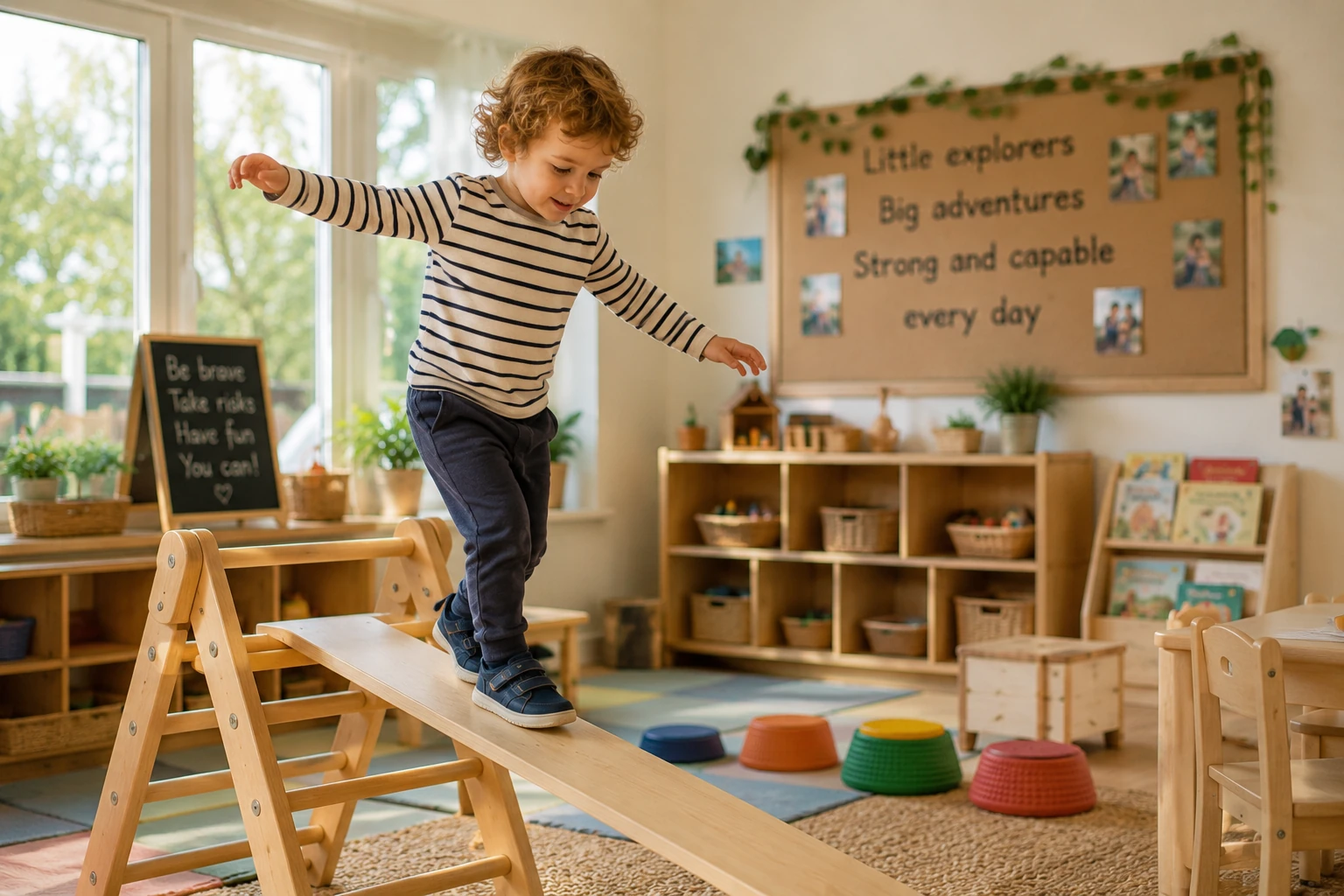
Risky play can look like climbing, balancing, jumping from heights, rolling, using tools, building things that might fall down, moving quickly, exploring independently, or even social moments like joining a group or speaking up.
Because risky play is not just climbing trees. It is every moment where a child is thinking:
“Can I do this?”
“What will happen if I try?”
“How far can I go safely?”
When children climb trees or take physical risks, most of the time they are not afraid — the adults watching them are.
We naturally say things like:
“Be careful.”
“Get down.”
“You’ll hurt yourself.”
“That’s too dangerous.”
“Let me do it.”
These reactions usually come from love and instinct. We want to protect children. That is completely natural. But sometimes our adult worry takes over what children are actually capable of doing safely. “Something might happen” becomes enough reason to stop the experience altogether.
We worry about falls, germs, mess, or near misses. But an important question is this: what happens if children never get the chance to learn how to move through risk for themselves?
Because avoiding all risk doesn’t remove risk from life. It only delays learning how to handle it.
Children learn so much in the “nearly” moments.
The nearly falling.
The nearly slipping.
The nearly losing balance.
The nearly going too fast.
A child who nearly falls learns where their body is stable. A child who lands awkwardly learns what to do differently next time. A child who goes too fast learns how to slow down and control their movement.
These moments are how children build confidence, coordination and judgement. They are not interruptions to learning… they are learning.
Children with SEND are often unintentionally overprotected. This usually comes from care and love, wanting to keep them safe above everything else. But safety should not take away independence, confidence or opportunity.
All children still need challenge. They need chances to explore, build body awareness, solve problems, try things that feel difficult, and experience the pride of doing something on their own.
Some children will need more support, more structure or more adult presence and that is okay. But inclusion should never mean removing challenge completely.
Many children with additional needs especially benefit from the movement and sensory experiences risky play brings. It helps them understand their bodies, develop coordination and balance, process sensory information, and grow confidence through achievement.
Inclusion is not about removing risk. It is about making sure every child has access to meaningful, appropriate challenge that helps them grow.
Most of us instinctively say “be careful.”
But if we always step in with fear or instructions, children stop learning how to think for themselves in those moments. Over time, children can begin to absorb the message that normal challenge is something to fear.
When children repeatedly experience anxiety around manageable risk, the body can move into a stress response, releasing cortisol — the hormone linked to stress and anxiety. In the brain’s formative early years, repeated experiences help shape how children respond to uncertainty, challenge and risk later in life.
Children need opportunities to assess, test and move through manageable risk for the parts of the brain responsible for judgement, emotional regulation and risk management to develop effectively. Without these experiences, children may become more hesitant to trust themselves, try new things or step outside their comfort zone.
This does not mean children should be exposed to danger. It means they need supported opportunities to experience challenge calmly and safely, with trusted adults nearby who guide rather than immediately remove the difficulty.
Instead, we can gently guide them by asking:
“What’s your plan?”
“Do you feel steady?”
“What could you hold onto?”
“Have you checked your footing?”
“What do you think might happen next?”
This helps children build their own awareness and judgement over time.
We also often rush in to help too quickly… lifting children up, fixing the problem, or removing the challenge.
But every time we take away a manageable struggle, we risk sending the message: “you can’t do this without me.”
Sometimes the most supportive thing we can do is pause and allow them to try.
Not step away. Not ignore risk. Just trust them a little more.
Risky play isn’t just climbing frames or outdoor learning.
At home, it might look like helping in the kitchen, climbing in the park, carrying things, building dens, riding bikes, messy play, balancing, exploring outside, trying new foods, pouring drinks, talking to new people or doing things independently.
Risk is part of everyday life.
Children need opportunities to experience it in small, supported ways while adults are nearby to guide them.
We don’t need to remove risk from childhood.
We need to help children learn how to move through it.
Scraped knees heal.
But children who never learn to feel comfortable with uncertainty may carry that fear far beyond childhood.
And sometimes, in trying so hard to keep children safe from every possible “what if,” we accidentally hold them back from becoming confident in their own abilities.
And maybe that is the real risk worth thinking about.