
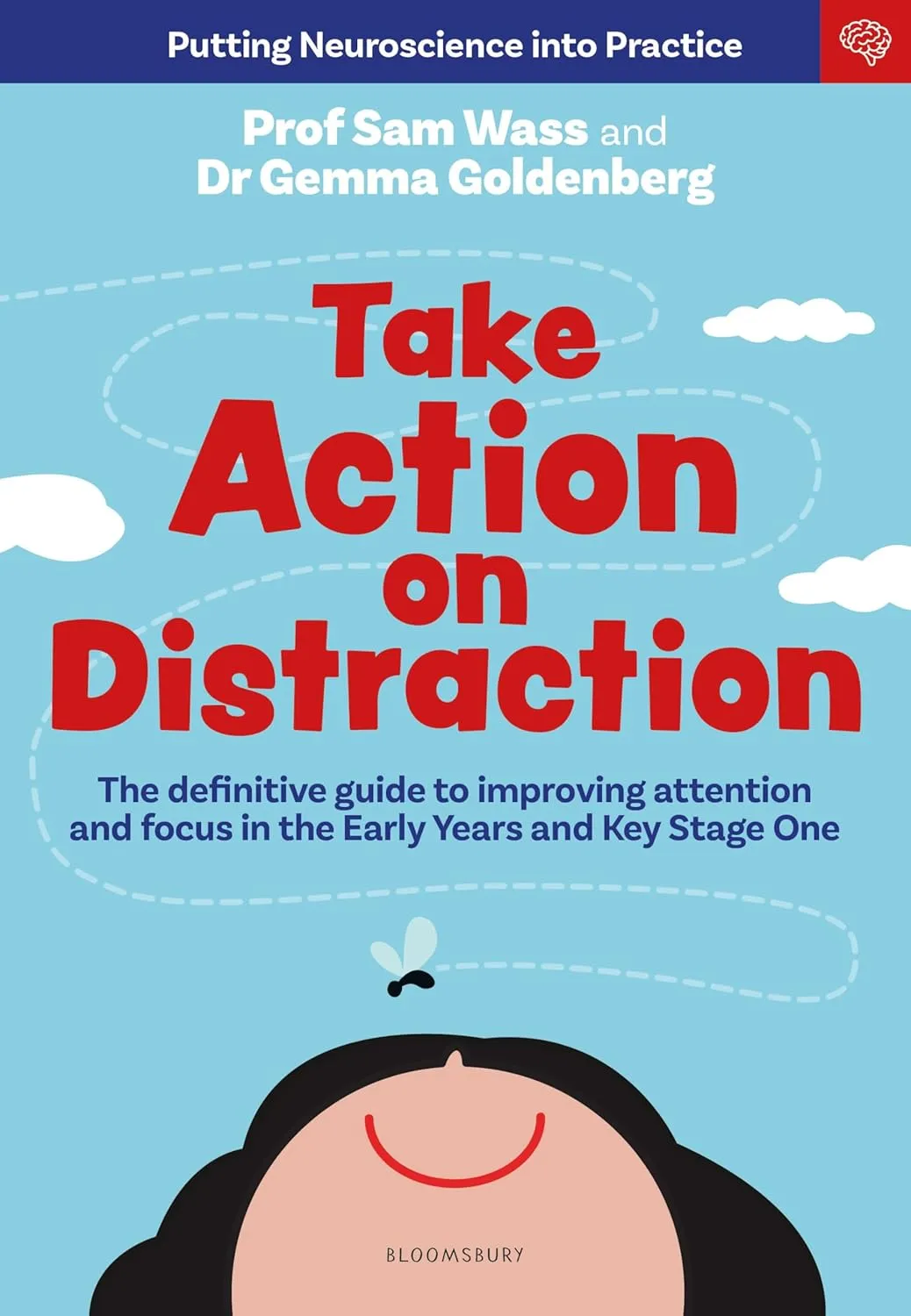
Are you interested in finding out about a new book “Take Action on Distraction”, which gives Early Years settings and parents a great insight into the attention of children. The authors, Dr Gemma Goldenberg and Professor Sam Wass present their latest neuroscience research on what affects a child's ability to focus.
Are you still there? Or have you been distracted? This blog will discuss some of the issues raised in 'Take Action on Distraction' …if you are still interested!
Attention Capture
Attention capture is when something new in your environment captures your attention, it's very useful to notice stuff that could do us harm. Attention capture happens when a child runs off when you are speaking to them, they've already listened to you for 10 seconds so anything new just noticed will capture their attention….even if what you was saying was very important!!
Attention Control
Attention control is about how our brain has also evolved to ignore lots of unimportant stuff so that we can focus on things that need our attention, useful for spotting our child at school sports day, focusing on the road when driving, or hearing what your friends are saying in a busy, noisy venue.
The neuroscience shows that young children have great skill at noticing new stuff, but they're no so good with attention control, which is a skill still developing well into primatry school. The authors use an analogy of a fly in the room; flies are very hard for us to ignore; a teacher cannot compete for children's attention with a fly buzzing around in a classroom.
Is the learning here that teachers and parents should be like flies when they want children's attention - with metaphorical zig zagging: slow to fast, loud to quiet, low to high, still to mobile. At Tiny Toes our Early Years Practitioners use variation in their voices, tone and speech rhythm to help children to listen, They also speak in an animated way with children while speaking, singing and reading to children so listening becomes a multi-sensory activity.
The book recognises neuro-diversity, that people experience and interact with the world in many different ways due to natural variations in brain function. The book suggests that training some children to sit still and stay quiet to listen could be counterproductive. Take Action on Distraction advocates different approaches for different children so that all children develop attention control skills through engagement rather than compliance. Children might not learn well if they are compelled to sit listening to a teacher, or worse they will learn to pay poor attention if they get in the habit of looking like they are paying attention when they actually aren't. Children might be more able to apply the skill of attention control to other things by first being able to practice paying attention doing the things that they naturally enjoy and can focus on. At Tiny Toes we encourage children to spend time playing at what they naturally find engaging, as they will probably learn more and develop more skills while they are fully engaged in play, iincluding attention control.
Our therapeutic approach tells us to avoid feeling frustrated when a child is not listening to us. It's about getting curious about why, rather than blaming or shaming the child. As a team we've tried implanting some of the approaches discussed in the book such as reducing noise, incorporating quiet/calm spaces, working in small groups, mindfulness sessions and being outdoors as well as having a child centred approach in our curriculum that allows space within the nursery routine for children to direct their own play according to their own unique interests.
So next time your child is not listening to you, don't worry too much, listening to you might not be the best thing for their learning at that time. You might be tempted to act like the buzzing fly to re-captivate your children, perhaps you'd do better being that still fly on the wall, unnoticed, quietly observing and learning about your child and how they are when free from your direction!